Corrugated
Slide sleeve
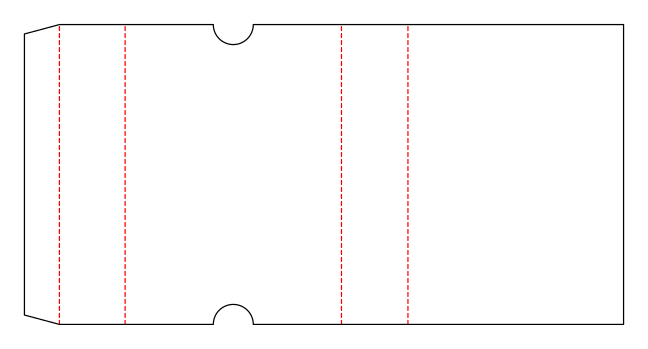
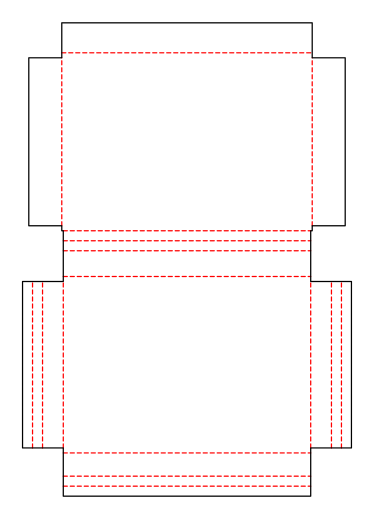
Corrugated tube with glue flap, open at both ends, with thumb notches on the top; an inner part (e.g., a corrugated tray) slides inside. Dimensions: inside cross-section × tube length.
Opens the online editor with this template. Try it without payment details; export with Pro.
- Template
- Slide sleeve
- Category
- Corrugated
- Dimension reference
- Inside dimensions
- Default dimensions
- 210 × 60 × 300 mm
- Parameters
- 4
- Version
- v1
- Template ID
- corrugated.slide
Dimensions and limits
Default dimensions of the template and the permitted range in mm.
| Dimension | Default | Range |
|---|---|---|
| Length | 210 mm | 20–1,200 mm |
| Width | 60 mm | 20–1,200 mm |
| Height | 300 mm | 50–1,200 mm |
Parameters of this construction
4 parameters with default value and limits, adjustable in the editor.
| Parameter | Default | Range | Note |
|---|---|---|---|
Glue flapglueFlap | 35 mm | 20–60 mm | Width of the glue flap used to glue the blank into a tube. The material requires a minimum width. |
Glue flap angleglueFlapAngle | 15° | 0–20° | Bevel at the ends of the glue flap; facilitates folding and erection. |
Thumb notchthumbNotch | on | on / off | Semicircular opening at the front edge for easy opening. |
Thumb notch radiusthumbNotchRadius | 20 mm | 10–40 mm | Radius (= depth) of the thumb notch. |
Assembly
Glue the glue flap to the underside and lay the sleeve flat. Erect for use and slide in the inner part; to open, push it out at the thumb notch.
Grain direction
Flute parallel to the tube: Wall creases fold along the flute, and the sleeve is stiff in the sliding direction (check with a test print shop).
Reference note
similar to FEFCO 0501 · classification unconfirmed
Labels such as “similar to FEFCO” or “ECMA family, unconfirmed” are for orientation only. The templates are our own constructions; an assignment to a standard code is unconfirmed and not a trademark claim.
Frequently asked questions about this template
Is the inner part calculated too?
No. The template generates only the sleeve. The catalog names a corrugated tray as a possible inner part, but a linked assembly is a subsequent step. Compare its finished outside dimensions with the sleeve's inside cross-section and test sliding on a sample. There is no automatic fit approval for both parts here.
At which ends are the thumb notches?
The template places thumb notches at both open ends of the top. thumbNotch toggles them together, and thumbNotchRadius controls their radius. The fitsFront constraint preserves material to the wall creases and between notches. Also check whether artwork or the inner part covers the intended grip location.
How much clearance does a tray need?
The source code provides no universally approved allowance for any inner part. Measure its finished outside dimensions including material layers and gluing. Determine the required sliding clearance with the target material in a complete sample. The sleeve's inside dimensions alone predict neither insertion force nor behavior after multiple sliding cycles.
Does the sleeve have a bottom closure?
No. It is a tube with a glued seam and two open ends. An inner part or the product slides inside. Closing one end or securing against falling out requires a separate construction or securing measure. This V1 includes neither bottom flaps nor an integrated end stop for that purpose.
Related templates
Customise the Slide sleeve in your browser
Set dimensions and material, review findings and export print-ready as PDF, SVG or DXF.