Folding cartons
Hinged lid tray (clamshell)
Tray with glued corners and a hinged lid for burgers, meals, and pastries; lid dust flaps inside against the end walls, with a tuck flap or slot closure. Default sizes: burger 110 × 110 × 80 mm, meal 230 × 180 × 70 mm.
Opens the online editor with this template. Try it without payment details; export with Pro.
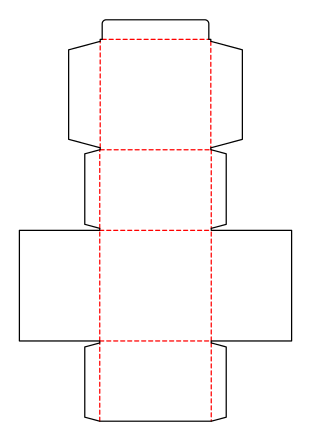
- Template
- Hinged lid tray (clamshell)
- Category
- Folding cartons
- Dimension reference
- Inside dimensions
- Default dimensions
- 110 × 110 × 80 mm
- Parameters
- 13
- Version
- v1
- Template ID
- carton.tray.hinged
Dimensions and limits
Default dimensions of the template and the permitted range in mm.
| Dimension | Default | Range |
|---|---|---|
| Length | 110 mm | 60–300 mm |
| Width | 110 mm | 60–300 mm |
| Height | 80 mm | 30–120 mm |
Parameters of this construction
13 parameters with default value and limits, adjustable in the editor.
| Parameter | Default | Range | Note |
|---|---|---|---|
Corner glue flapcornerFlapWidth | 15 mm | 8–40 mm | Width of the glue flaps at the ends of the front and back walls, glued to the inside of the end walls. The material requires a minimum width; the flaps from both sides must not meet on the end wall. |
Corner glue flap tapercornerFlapAngle | 15° | 0–30° | Bevel at both ends of the corner glue flaps; the flap does not catch on the base or upper edge during erection. |
Flap gapflapGap | 2 mm | 0.2–5 mm | Gap between neighboring flaps or walls; at least approximately the material thickness. |
Lid dust flaps (ratio)lidFlapRatio | 40 % | 10–90 % | Length of the lid's dust flaps as a ratio of the inside height. |
Dust flap angledustFlapAngle | 15° | 0–30° | Bevel of the dust flaps (also the ears on the mailer); larger angles prevent collisions during folding. |
Lid closurelidLock | tuck | tuck · slot | How the lid closes: a tuck flap inside behind the front wall, or a slot closure with the lid front wall outside and a tab through a slot. |
Tuck depthtuckDepth | 20 mm | 10–60 mm | How far the tuck flap reaches into the box; at most approximately half the width (the height for the mailer). For this tray, at most 0.8 × height. |
Tuck flap radiustuckRadius | 4 mm | 0–15 mm | Corner radius of the tuck flap; limited by half the flap width or tuck depth. For this tray, at most half the tuck depth. |
Tuck flap shouldertuckShoulder | 2 mm | 0.5–10 mm | Side inset of the tuck flap relative to the lid, allowing easy insertion. |
Lid overhanglidOverhang | 15 mm | 10–60 mm | Height of the lid front wall that overlaps the front on the outside; at most half the height. The slot in the front is positioned at this height. |
Lid tuck depthlidTabDepth | 10 mm | 5–25 mm | How far the tuck flap on the lid front wall reaches through the slot into the box; at most half the width. |
Lid tuck widthlidTabWidth | 40 mm | 10–150 mm | Width of the tuck flap on the lid front wall; the slot in the front is 2 mm longer. A shoulder of at least 3 mm remains on each side. |
Slit widthslitWidthExpert | 0 mm | 0–3 mm | Width of the slots or incisions; 0 = blade cut. The machine requires a minimum slot width. |
Assembly
Erect the front and back walls, fold the corner glue flaps inward and apply adhesive to their outside faces, then erect and press the end walls into place. Fill the tray, fold in the lid dust flaps, and close the lid: insert the tuck flap behind the front wall, or place the lid front wall over the front wall and push the tab through the slot.
Grain direction
Grain direction parallel to the length, as for the tray: base, hinge, and flap creases lengthwise; end-wall and dust-flap creases crosswise. The lid springs open less at the hinge (check with a test print shop).
Reference note
ECMA family D, unconfirmed
Labels such as “similar to FEFCO” or “ECMA family, unconfirmed” are for orientation only. The templates are our own constructions; an assignment to a standard code is unconfirmed and not a trademark claim.
Frequently asked questions about this template
What is the difference between a tuck flap and a tab-and-slot closure?
The tuck flap engages inside behind the front wall. The tab-and-slot closure guides a tab through a slot while the lid front wall lies outside over the front wall. lidLock selects the construction type. The two solutions need different parameters and change the lid contour. Test opening, closing, and artwork position for the selected version.
Is the height the height of the base section?
The height describes the tray wall height. The lid is flat and sits over the opening; it does not form a second raised tray. Inside and outside dimensions refer to the closed construction. For a product that extends above the tray, determine the required inside space and check the lid closure on the filled sample.
Do all four corners need to be glued?
Yes, this construction uses four corner glue flaps on the front and back walls. They fold inward, receive adhesive on the outside, and are pressed against the end walls. They do not replace interlocking corners. Their width depends on the material minimum and available space. A valid blank does not establish the strength of the actual glue joint.
Why is the default slot width 0 mm?
For the slot closure, the slitWidth parameter also describes a knife cut without material removal. 0 mm means this open cut. MFG-004 checks closed slots and notches with material removed, rather than individual open cuts. Confirm with the manufacturer whether this type of cut can be used and how the tab passes through it in the intended paperboard.
Can the burger box also serve as a meal box?
The catalog documents 230 × 180 × 70 mm as the default meal size and 200 × 150 × 40 mm as a shallow pastry size. These are new dimension sets for the same construction. Check the flap parameters before reusing them: lid dust flaps, tuck depth, and machine sheet size must work together with the new dimensions.
Related templates
Customise the Hinged lid tray (clamshell) in your browser
Set dimensions and material, review findings and export print-ready as PDF, SVG or DXF.