Corrugated
Pizza box
Low corrugated pizza box: double side walls with locking corners and locking tabs, lid on the back wall with tuck flap and ventilation slots; erected without glue. Starting sizes 26, 30, 33, and 40 cm inside dimensions.
Opens the online editor with this template. Try it without payment details; export with Pro.
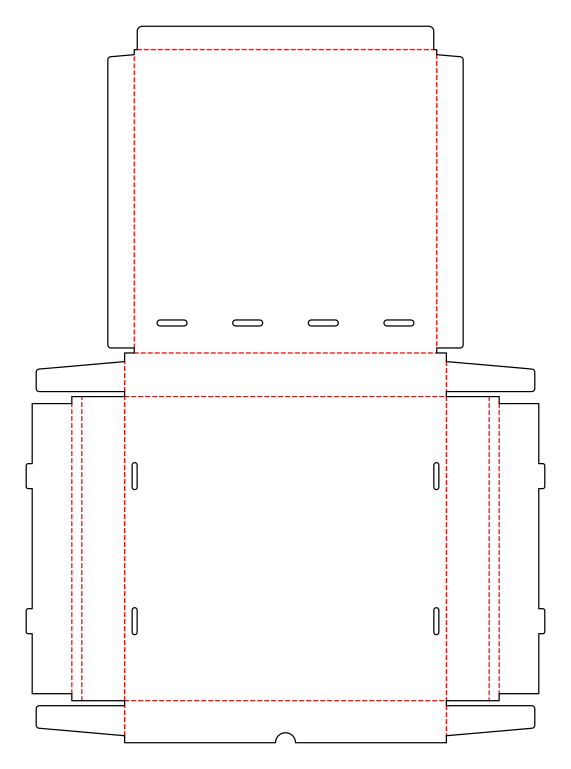
- Template
- Pizza box
- Category
- Corrugated
- Dimension reference
- Inside dimensions
- Default dimensions
- 300 × 300 × 40 mm
- Parameters
- 20
- Version
- v1
- Template ID
- carton.pizza
Dimensions and limits
Default dimensions of the template and the permitted range in mm.
| Dimension | Default | Range |
|---|---|---|
| Length | 300 mm | 150–500 mm |
| Width | 300 mm | 150–500 mm |
| Height | 40 mm | 25–80 mm |
Parameters of this construction
20 parameters with default value and limits, adjustable in the editor.
| Parameter | Default | Range | Note |
|---|---|---|---|
Rim widthrimWidth | 10 mm | 3–20 mm | Width of the double wall's foldover (crease to crease); accommodates the flaps in the pocket. |
Flap gapflapGap | 5 mm | 1–10 mm | Gap between neighboring flaps or walls; at least approximately the material thickness. |
Ear length (ratio)earRatio | 60 % | 50–95 % | Length of the ears or corner flaps as a ratio of half the inside width. |
Lid dust flaps (ratio)lidFlapRatio | 70 % | 30–95 % | Length of the lid's dust flaps as a ratio of the inside height. |
Dust flap angledustFlapAngle | 5° | 0–30° | Bevel of the dust flaps (also the ears on the mailer); larger angles prevent collisions during folding. |
Tuck depthtuckDepth | 25 mm | 10–80 mm | How far the tuck flap reaches into the box; at most approximately half the width (the height for the mailer). For this low construction, no more than 0.8 × height. |
Tuck flap radiustuckRadius | 5 mm | 0–20 mm | Corner radius of the tuck flap; limited by half the flap width or tuck depth. |
Tuck flap shouldertuckShoulder | 3 mm | 1–15 mm | Side inset of the tuck flap relative to the lid, allowing easy insertion. |
Lock tabslockTabs | on | on / off | Locks the inner walls with tabs in slots in the base. |
Number of lock tabslockTabCount | 2 | 1–4 | Number of locking tabs per wall. |
Lock tab widthlockTabWidth | 25 mm | 10–60 mm | Width of a locking tab. |
Lock tab depthlockTabDepth | 6 mm | 2–15 mm | How far a locking tab protrudes; at least material thickness plus clearance. |
Bottom slot widthslotWidth | 5 mm | 1–10 mm | Width of the slots in the base for the locking tabs; at least the material thickness, with clearance from the crease. |
Thumb notchthumbNotch | on | on / off | Semicircular opening at the front edge for easy opening. |
Thumb notch radiusthumbNotchRadius | 10 mm | 5–30 mm | Radius (= depth) of the thumb notch. |
Vent slotsvents | on | on / off | Oblong slots in the lid through which steam escapes so the pizza base does not become soggy. |
Number of vent slotsventCount | 4 | 1–8 | Slots in a row parallel to the lid hinge, evenly distributed over the lid length. |
Vent slot lengthventLength | 30 mm | 10–80 mm | Length of each slot parallel to the hinge; a 10 mm bridge remains between slots and to the lid edge. The entire row must fit on the lid with a 10 mm bridge per slot. |
Vent slot widthventWidth | 6 mm | 3–10 mm | Width of the oblong slots with rounded ends; no more than half the slot length. The die-cutting process requires a minimum slot width. |
Vent distance from hingeventInset | 30 mm | 15–150 mm | Distance of the slot center from the lid hinge; a 10 mm bridge remains to the tuck flap. |
Assembly
Erect front and back walls and fold the ears inward. Erect side walls, fold the rollover inward over the ears, and press the tabs into the bottom slots. Insert the pizza, fold in the lid dust flaps, close the lid, and tuck the tuck flap behind the front wall.
Grain direction
Flute direction parallel to blank height as with the mailer: side wall and rollover creases along the flute, lid hinge across it; the large lid sags less (check with the corrugated print shop).
Reference note
similar to FEFCO 0427 · classification unconfirmed
Labels such as “similar to FEFCO” or “ECMA family, unconfirmed” are for orientation only. The templates are our own constructions; an assignment to a standard code is unconfirmed and not a trademark claim.
Frequently asked questions about this template
Which dimensions apply to a 30-cm pizza?
The example uses inside dimensions 300 × 300 × 40 mm. However, the designation 30 cm does not replace measuring the topped pizza and required clearance. Check height, rim, and insertion on a sample. The catalog also lists 260, 330, and 400 mm as starting sizes; each size is recalculated, not generated by scaling.
Can I disable ventilation slots?
Yes, vents toggles lid ventilation. With ventilation enabled, count, length, width, and distance from the hinge determine the row of oblong slots. Constraints limit their extent and preserve bridges. The geometry does not simulate steam transport; you must assess its effect on the packaged pizza with actual filling and transit duration.
Why does the starting example report corner warnings?
The tab roots contain sharp inside corners. The machine profile sets a knife minimum of 2 mm, and MFG-002 reports eight warnings. Export remains possible because these findings do not block it. That does not make them disappear. Coordinate with the die-cutting shop how the corners will be made and whether the actual material develops tears or locking problems.
Is this construction a confirmed reference?
The catalog classification is similar to FEFCO 0427 and is unconfirmed. The dieline is our own parametric construction. The note classifies the construction and confirms neither a standards-compliant drawing nor production approval. For a specific manufacturing project, the material profile, machine requirements, and a tested physical sample remain the relevant next steps.
Related templates
Customise the Pizza box in your browser
Set dimensions and material, review findings and export print-ready as PDF, SVG or DXF.