Folding cartons
Cup sleeve
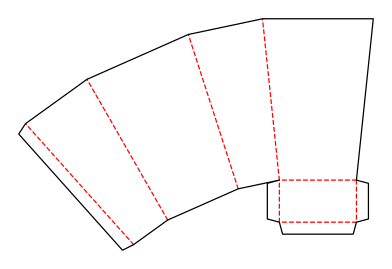
Heat-protection sleeve (Coffee Sleeve) for paper cups: truncated cone wall as an annular sector with a glue flap, made from carton board or E-flute microcorrugated board. Dimensions: cup diameter at the top and bottom edges of the sleeve, sleeve height, glue flap width.
Opens the online editor with this template. Try it without payment details; export with Pro.
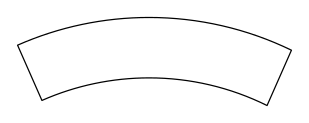
- Template
- Cup sleeve
- Category
- Folding cartons
- Dimension reference
- Nominal size
- Default dimensions
- 60 × 85 × 69 × 12 mm
- Parameters
- 1
- Version
- v1
- Template ID
- sleeve.cup
Dimensions and limits
Default dimensions of the template and the permitted range in mm.
| Dimension | Default | Range |
|---|---|---|
| Height | 60 mm | 30–120 mm |
| Top diameter | 85 mm | 40–150 mm |
| Bottom diameter | 69 mm | 40–150 mm |
| Overlap | 12 mm | 6–25 mm |
Parameters of this construction
1 parameters with default value and limits, adjustable in the editor.
| Parameter | Default | Range | Note |
|---|---|---|---|
Diameter allowancesleeveAllowance | 1 mm | 0–3 mm | Clearance added to the cup diameter so the sleeve slides easily over the cup; no greater than 5 % of the bottom diameter. Material thickness is accounted for separately. |
Assembly
Apply adhesive to the glue flap, roll the segment into a cone, and align the starting end flush on the glue flap; press together and allow to cure laid flat. To use, open it out and slide it over the cup from below until it fits snugly.
Grain direction
Grain direction along the circumference (across the height): the sleeve bends more easily around the cup axis and does not crack (check with a test print shop).
Reference note
No external reference assigned; original construction type.
Labels such as “similar to FEFCO” or “ECMA family, unconfirmed” are for orientation only. The templates are our own constructions; an assignment to a standard code is unconfirmed and not a trademark claim.
Frequently asked questions about this template
Is specifying 12 oz enough for the construction?
No. The starting example uses 85 mm at the top, 69 mm at the bottom, and a sleeve height of 60 mm. These diameters are at the sleeve edges, not necessarily at the cup rim and base. Cups from different suppliers can have different shapes at the same volume. Measure at the intended seating position and test a sleeve on the original cup.
Do I need to add material thickness myself?
No. The input describes the cup at the contact edges. The model derives neutral diameters using material thickness and sleeveAllowance. Adding thickness beforehand would count it twice. Change the material profile and recalculate if you switch from carton board to microcorrugated board; then check the fit again.
What is the difference between a sleeve and a cone wall?
The sleeve surrounds an existing cup and receives a diameter allowance for sliding it on. It has neither a bottom nor a top rolled rim. The cone wall for cups is the actual sidewall, with separate rolling allowances. Both are annular sectors but have different dimension references and assembly tasks.
Can the sleeve fit a cylinder?
This template requires at least 2 mm difference between top and bottom diameters. Below that, the conical blank does not fit the intended model. A wrap band is the appropriate starting shape for a cylinder. Even within the permitted taper, fit must be checked because the allowance affects the final seating height on a tapered cup.
Does the folding preview show the sleeve closed?
The catalog documentation describes the sleeve as a curved panel and shows it flat in the 3D preview. Its calculated closure is checked separately. A flat view therefore does not imply a rolling error. For practical acceptance, the glue seam, opening it out, and seating height on the actual cup remain decisive; proof of heat protection is not included.
Related templates
Customise the Cup sleeve in your browser
Set dimensions and material, review findings and export print-ready as PDF, SVG or DXF.