Folding cartons
Takeout box
Trapezoidal box for takeout food: outward-sloping front and back walls, glued corners, folding lid with a tuck flap; optionally a pair of holes in the end walls for a carrying handle (holes only, no wire).
Opens the online editor with this template. Try it without payment details; export with Pro.
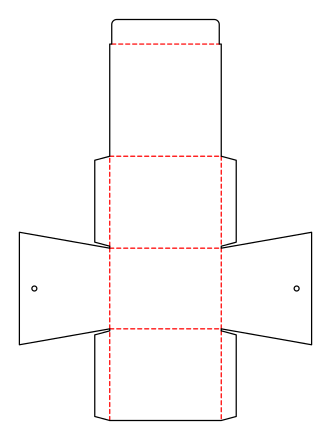
- Template
- Takeout box
- Category
- Folding cartons
- Dimension reference
- Inside dimensions
- Default dimensions
- 110 × 80 × 90 mm
- Parameters
- 10
- Version
- v1
- Template ID
- carton.takeout
Dimensions and limits
Default dimensions of the template and the permitted range in mm.
| Dimension | Default | Range |
|---|---|---|
| Length | 110 mm | 60–250 mm |
| Width | 80 mm | 50–200 mm |
| Height | 90 mm | 40–150 mm |
Parameters of this construction
10 parameters with default value and limits, adjustable in the editor.
| Parameter | Default | Range | Note |
|---|---|---|---|
Wall flareflareAngle | 10° | 0–20° | Outward slope of the front and back walls relative to vertical; the top opening becomes wider by 2 × height × tan(slope), and the end walls become trapezoids. |
Corner glue flapcornerFlapWidth | 15 mm | 8–40 mm | Width of the glue flaps at the ends of the front and back walls, glued to the inside of the end walls. The material requires a minimum width; the flaps from both sides must not meet on the end wall. |
Corner glue flap tapercornerFlapAngle | 15° | 0–30° | Bevel at both ends of the corner glue flaps; the flap does not catch on the bottom or top edge during erection. At least equal to wall slope flareAngle. |
Flap gapflapGap | 2 mm | 0.2–5 mm | Gap between neighboring flaps or walls; at least approximately the material thickness. |
Tuck depthtuckDepth | 25 mm | 10–60 mm | How far the tuck flap reaches into the box; at most approximately half the width (the height for the mailer). For this box, at most half the height. |
Tuck flap radiustuckRadius | 5 mm | 0–15 mm | Corner radius of the tuck flap; limited by half the flap width or tuck depth. |
Tuck flap shouldertuckShoulder | 2 mm | 0.5–10 mm | Side inset of the tuck flap relative to the lid, allowing easy insertion. |
Handle hole pairhandleHoles | on | on / off | One round hole centered below the top edge of each end wall, as a mark for a carrying handle. |
Handle hole diameterhandleHoleDiameter | 5 mm | 3–10 mm | Diameter of the two round holes; the die cutter requires a minimum diameter. |
Handle hole distancehandleHoleInset | 15 mm | 8–40 mm | Distance of the hole center from the end wall's top edge; at least one and a half times the diameter, at most a quarter of the height. |
Assembly
Erect the front and back walls, fold the corner glue flaps inward and apply adhesive to their outside, erect the end walls, and press into place. Fill, close the lid, and tuck the tuck flap behind the front wall. If required, thread a carrying handle through the handle holes.
Grain direction
Grain direction parallel to the length: bottom, hinge, and flap creases run lengthwise, and the sloping wall creases fold cleanly (check with the test print shop).
Reference note
No external reference assigned; original construction type.
Labels such as “similar to FEFCO” or “ECMA family, unconfirmed” are for orientation only. The templates are our own constructions; an assignment to a standard code is unconfirmed and not a trademark claim.
Frequently asked questions about this template
Where do I measure width?
For inside dimension, measure width at the bottom. For outside dimension, width refers to the upper opening. The front and back walls slope outward, so these reference points differ. Height is measured vertically. Record the chosen dimension reference during coordination to avoid confusing bottom and opening.
Is a carrying handle included in the export?
No. handleHoles enables one round hole in each end wall. Diameter and distance from the top edge are parameters. No wire or handle is generated. You must determine its shape, attachment, and load capacity separately. The model limits hole position geometrically but simulates neither tear-out nor transport of a filled box.
Can I make the walls vertical?
flareAngle permits 0°, producing a rectangular cuboid starting shape. Larger angles enlarge the top opening. The model limits this enlargement and requires a matching corner glue flap bevel. Change both together when increasing the slope. Then check lid closure and corners, as their position changes with the angle.
Why does the corner flap need a matching bevel?
The front and back walls slope while the end walls remain vertical. To avoid the corner glue flaps obstructing this shape, their bevel must be at least equal to the wall slope. When both angles are equal, the remaining notch can be very narrow. MFG-004 evaluates this point using the machine profile; assembly in the target board must also be checked.
Is the bottom guaranteed leakproof?
The template has a bottom and glued corners. Geometry calculates their position but not tightness against liquids or grease. Coating, adhesive, processing, and filling must be checked in the actual material structure. An export without blocking findings does not replace this evidence or confirm any particular use of the takeout box.
Related templates
Customise the Takeout box in your browser
Set dimensions and material, review findings and export print-ready as PDF, SVG or DXF.