Folding cartons
Carton with crash-lock bottom
Folding carton with a tuck flap at the top and a pre-glued crash-lock bottom that closes by itself when erected.
Opens the online editor with this template. Try it without payment details; export with Pro.
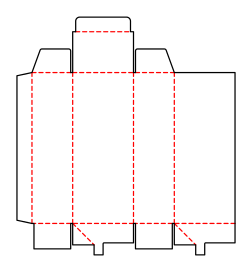
- Template
- Carton with crash-lock bottom
- Category
- Folding cartons
- Dimension reference
- Inside dimensions
- Default dimensions
- 60 × 40 × 150 mm
- Parameters
- 12
- Version
- v1
- Template ID
- carton.crashlock
Dimensions and limits
Default dimensions of the template and the permitted range in mm.
| Dimension | Default | Range |
|---|---|---|
| Length | 60 mm | 20–200 mm |
| Width | 40 mm | 20–200 mm |
| Height | 150 mm | 20–200 mm |
Parameters of this construction
12 parameters with default value and limits, adjustable in the editor.
| Parameter | Default | Range | Note |
|---|---|---|---|
Glue flapglueFlap | 15 mm | 8–25 mm | Width of the glue flap used to glue the blank into a tube. The material requires a minimum width. |
Glue flap angleglueFlapAngle | 12° | 0–20° | Bevel at the ends of the glue flap; facilitates folding and erection. |
Tuck depthtuckDepth | 15 mm | 10–30 mm | How far the tuck flap reaches into the box; at most approximately half the width (the height for the mailer). |
Tuck flap radiustuckRadius | 4 mm | 0–10 mm | Corner radius of the tuck flap; limited by half the flap width or tuck depth. |
Tuck flap shouldertuckShoulder | 3 mm | 2–6 mm | Side inset of the tuck flap relative to the lid, allowing easy insertion. |
Dust flap length (ratio)dustFlapRatio | 80 % | 50–95 % | Dust flap length as a ratio of the available length. |
Dust flap angledustFlapAngle | 20° | 0–45° | Bevel of the dust flaps (also the ears on the mailer); larger angles prevent collisions during folding. |
Bottom wing overlapwingOverlap | 10 mm | 2–40 mm | Overlap of the folding wings in the closed crash-lock bottom. |
Lock stylelockStyle | hook | hook · none | Lock shape in the crash-lock bottom: hook or no lock. |
Hook steplockStep | 6 mm | 2–20 mm | Step of the hook contour; at least half the overlap, at most as much as the opening allows. |
Glue field widthglueFieldWidth | 5 mm | 3–15 mm | Width of the glue field on the bottom wings' flap. |
Glue field gapglueFieldGapExpert | 2 mm | 1–5 mm | Distance of the glue field from the diagonal crease and flap edges; at least the material thickness. |
Assembly
At the factory: fold bottom wings back at the diagonal creases, apply adhesive to glue fields, lay the body flat, and glue the glue flap. At the customer's site: erect the body – the bottom closes by itself. After filling, fold in the dust flaps and insert the tuck flap.
Grain direction
Grain direction parallel to height (check)
Reference note
ECMA family, unconfirmed
Labels such as “similar to FEFCO” or “ECMA family, unconfirmed” are for orientation only. The templates are our own constructions; an assignment to a standard code is unconfirmed and not a trademark claim.
Frequently asked questions about this template
What is automatic about the crash-lock bottom?
The prepared bottom closes as the flat body is erected. For this, the bottom wings must first have been folded and glued at the factory. The construction does not eliminate this preparation step. Check the complete workflow from pre-gluing to filling with the selected board.
Can I use the bottom without pre-gluing?
The assembly instructions assume glue fields and factory pre-gluing. Without this preparation, the intended automatic workflow does not occur. If you need a bottom without gluing, the snap-lock bottom is a different construction in the catalog. You must check its flaps and folding sequence separately.
Which board is the example based on?
The documented starting example uses folding carton board 400 g/m². Basis weight alone, however, determines neither thickness nor creasing behavior. The profile is not calibrated. Agree on material, creasing, and gluing with the print shop and check the bottom on a sample made from the target material.
What is the bottom's load capacity?
No reliable weight specification is available for this page. The geometry describes bottom wings and glue fields but does not test the strength of the eventual bond. Product weight, adhesive, and board must be tested together. Prototypes in three sizes and their documented results are still pending in the catalog.
Which reference may I cite?
For this template, the public reference remains ECMA family, unconfirmed. It provides orientation and is shown without a letter code. No standard texts or standard drawings are reproduced. The original parametric construction and confirmation by a technical partner are separate steps; confirmation is still pending.
Related templates
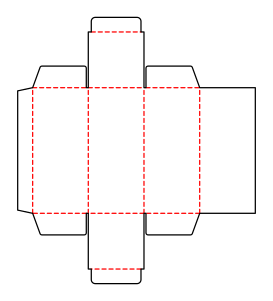 Folding cartonsStraight tuck end cartoncarton.tuckend.straight
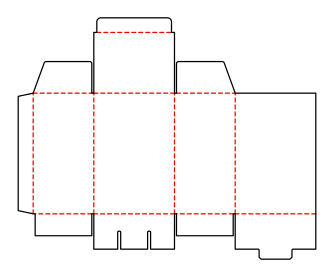 Folding cartonsCarton with snap-lock bottomcarton.snaplock
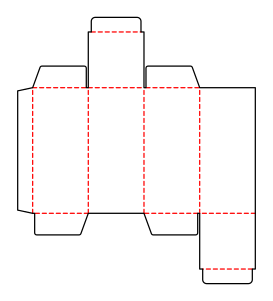 Folding cartonsReverse tuck end cartoncarton.tuckend.reverse
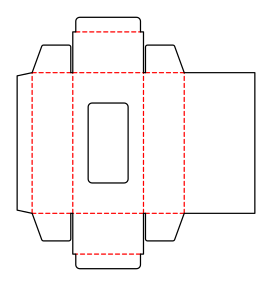 Folding cartonsTuck end carton with windowcarton.window
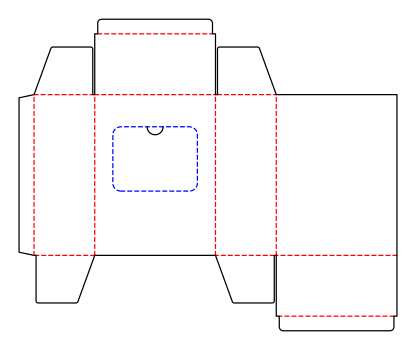 Folding cartonsDispenser carton with tear-out windowcarton.dispenser
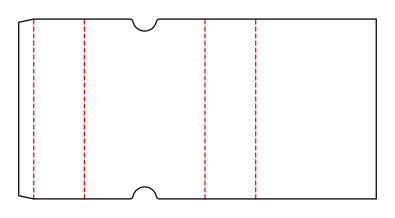 Folding cartonsSleevecarton.sleeve
Customise the Carton with crash-lock bottom in your browser
Set dimensions and material, review findings and export print-ready as PDF, SVG or DXF.