Folding cartons
Reverse tuck end carton
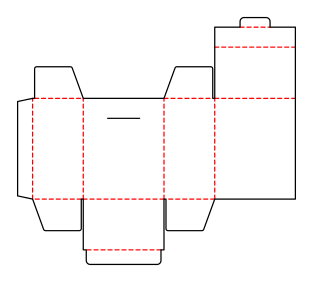
Like the straight tuck end carton, but the lower tuck flap is attached to the back; the flaps tuck in from opposite sides.
Opens the online editor with this template. Try it without payment details; export with Pro.
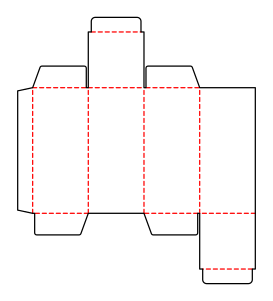
- Template
- Reverse tuck end carton
- Category
- Folding cartons
- Dimension reference
- Inside dimensions
- Default dimensions
- 55 × 55 × 125 mm
- Parameters
- 18
- Version
- v3
- Template ID
- carton.tuckend.reverse
Dimensions and limits
Default dimensions of the template and the permitted range in mm.
| Dimension | Default | Range |
|---|---|---|
| Length | 55 mm | 20–200 mm |
| Width | 55 mm | 20–200 mm |
| Height | 125 mm | 20–200 mm |
Parameters of this construction
18 parameters with default value and limits, adjustable in the editor.
| Parameter | Default | Range | Note |
|---|---|---|---|
Glue flapglueFlap | 15 mm | 8–25 mm | Width of the glue flap used to glue the blank into a tube. The material requires a minimum width. |
Glue flap angleglueFlapAngle | 12° | 0–20° | Bevel at the ends of the glue flap; facilitates folding and erection. |
Tuck depthtuckDepth | 15 mm | 10–30 mm | How far the tuck flap reaches into the box; at most approximately half the width (the height for the mailer). |
Tuck flap radiustuckRadius | 4 mm | 0–10 mm | Corner radius of the tuck flap; limited by half the flap width or tuck depth. |
Tuck flap shouldertuckShoulder | 3 mm | 2–6 mm | Side inset of the tuck flap relative to the lid, allowing easy insertion. |
Dust flap length (ratio)dustFlapRatio | 80 % | 50–95 % | Dust flap length as a ratio of the available length. |
Dust flap angledustFlapAngle | 20° | 0–45° | Bevel of the dust flaps (also the ears on the mailer); larger angles prevent collisions during folding. |
Dust flap reliefdustFlapReliefExpert | 2 mm | 1–5 mm | Distance between dust flap and lid along the crease; at least the material thickness. The machine requires a minimum slot width. |
Lock slitlockSlit | off | on / off | Adds tabs to the tuck flap and matching slots at the crease; the flap locks into place. |
Lock tab widthlockTabWidth | 12 mm | 5–30 mm | Width of a locking tab. |
Lock tab depthlockTabDepth | 3 mm | 2–6 mm | How far a locking tab protrudes; at least material thickness plus clearance. |
Slit lengthslitLength | 14 mm | 7–40 mm | Length of the locking slots; at least as long as the tab is wide. |
Slit widthslitWidthExpert | 0 mm | 0–3 mm | Width of the slots or incisions; 0 = blade cut. The machine requires a minimum slot width. |
Hang holehangHole | none | none · euro · round · slot | Hole for hanging on a retail shelf: Euro slot (elongated slot with a round hole above), round hole, or slot. On cartons and the gift card holder, it is centered in a header above the top edge. |
Hole widthhangHoleWidth | 30 mm | 10–60 mm | Width of the elongated slot in the Euro slot and slot options. |
Slot heighthangHoleHeight | 5 mm | 2–10 mm | Height of the elongated slot in the Euro slot and slot options; the ends are semicircular. |
Hole diameterhangHoleDiameter | 10 mm | 3–20 mm | Diameter of the round hole or circle above the elongated slot in the Euro slot; larger than slot height for the Euro slot. |
Header heighthangTabHeight | 25 mm | 15–60 mm | Height of the header above the top edge; the hole sits at its center and maintains at least a 3 mm bridge to all edges. |
Assembly
Pre-break the blank along all creases. Glue the glue flap to the inside of the opposite wall and flatten the carton. Erect for filling, fold in the dust flaps, and insert the tuck flaps from the front and back.
Grain direction
Grain direction parallel to the height: wall creases run along the grain direction and fold cleanly (check with the test print shop).
Reference note
ECMA family, unconfirmed
Labels such as “similar to FEFCO” or “ECMA family, unconfirmed” are for orientation only. The templates are our own constructions; an assignment to a standard code is unconfirmed and not a trademark claim.
Frequently asked questions about this template
Where is the lower tuck flap attached?
It is attached to the back; the upper one remains at the front. The closures therefore tuck in from opposite walls. For artwork, inspect the bottom panel and its reading orientation on the erected sample. A printed design for the straight variant therefore cannot be transferred to the reverse arrangement without checking.
When do I need the dust flap relief cut?
V2 and V3 include dustFlapRelief. This clearance separates the dust flap and lid along the crease and must suit material thickness and the machine minimum. Do not reduce it solely to pack the outline more tightly. Check the relief cut during pre-breaking and folding in the lower flaps with the final board.
Is the hanging hole always present?
No. Version 3 starts with hangHole=none. Only a different selection creates the header at the back and the corresponding cutout. Width, height, or diameter depend on hole shape. Check the remaining webs and actual hanging on the sample; the export confirms no load capacity.
Related templates
Customise the Reverse tuck end carton in your browser
Set dimensions and material, review findings and export print-ready as PDF, SVG or DXF.