Folding cartons
Pillow box
Folding carton made from two walls with a glue flap and lens-shaped end flaps along curved creases; closing it curves the walls into a pillow shape. Dimensions: width × thickness × length.
Opens the online editor with this template. Try it without payment details; export with Pro.
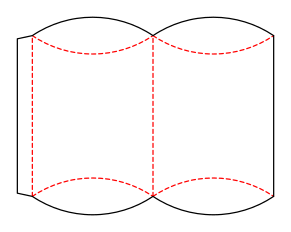
- Template
- Pillow box
- Category
- Folding cartons
- Dimension reference
- Inside dimensions
- Default dimensions
- 120 × 36 × 160 mm
- Parameters
- 11
- Version
- v2
- Template ID
- carton.pillow
Dimensions and limits
Default dimensions of the template and the permitted range in mm.
| Dimension | Default | Range |
|---|---|---|
| Length | 120 mm | 40–250 mm |
| Width | 36 mm | 10–100 mm |
| Height | 160 mm | 40–300 mm |
Parameters of this construction
11 parameters with default value and limits, adjustable in the editor.
| Parameter | Default | Range | Note |
|---|---|---|---|
Glue flapglueFlap | 15 mm | 8–25 mm | Width of the glue flap used to glue the blank into a tube. The material requires a minimum width. |
Glue flap angleglueFlapAngle | 12° | 0–20° | Bevel at the ends of the glue flap; facilitates folding and erection. |
End flap arc heightflapArcRatio | 100 % | 60–100 % | Height of the end flap's cut arc as a proportion of the crease arc's height (half the thickness); 100 % creates a symmetrical lens that fully covers the end. |
Windowwindow | off | on / off | |
Window shapewindowShape | rectangle | rectangle · oval | |
Window widthwindowWidth | 60 mm | 10–400 mm | |
Window heightwindowHeight | 60 mm | 10–400 mm | |
Window corner radiuswindowCornerRadius | 4 mm | 1–20 mm | |
Window position horizontalwindowPositionX | 50 % | 20–80 % | |
Window position verticalwindowPositionY | 50 % | 20–80 % | |
Film marginfilmMargin | 6 mm | 3–12 mm |
Assembly
Carefully pre-break the curved creases. Glue the glue flap to the inside of the free edge of the back and lay the package flat. To fill it, gently push the walls apart, press the lower end flaps inward in sequence, fill, and close the upper end flaps in the same way.
Grain direction
Grain direction parallel to the length (height): The walls curve around an axis along the grain and bend more easily; the side creases run along the grain (check with a test print shop).
Reference note
ECMA family, unconfirmed
Labels such as “similar to FEFCO” or “ECMA family, unconfirmed” are for orientation only. The templates are our own constructions; an assignment to a standard code is unconfirmed and not a trademark claim.
Frequently asked questions about this template
Which dimensions do I enter for the pillow box?
The technical length is the width from side edge to side edge, the technical width is the thickness at the center, and the height is the length from tip to tip. The table explicitly names these meanings. The curved ends reduce usable space; check product fit in an erected package.
Why is a very flat size rejected?
Thickness must be at least 20 % of the entered width. Below this limit, the notches between end flaps become too narrow. Thickness must also be no more than 50 % of the width, and package length must be at least twice the thickness. Individual values within the table range therefore do not guarantee a valid combination.
Can I adjust the end flap radius?
Version 1 does not provide a separate flap radius. Instead, you control flapArcRatio, the cut arc's height as a proportion of the crease arc's height. The starting value of 100 % creates the symmetrical lens. Check changes particularly at the tips and when pressing inward; crease arc height still follows from thickness.
Does the folding preview show the actual curvature?
The existing 3D model shows the pillow walls as flat. It therefore confirms neither a realistic curved shape nor reliable product fit in the curved interior. Use the dieline for a sample made from the intended board and check pre-breaking, end flaps, and filling on the actual package.
Related templates
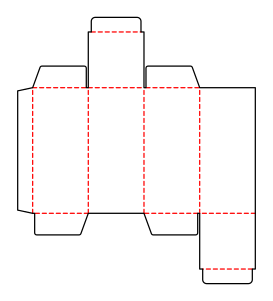 Folding cartonsReverse tuck end cartoncarton.tuckend.reverse
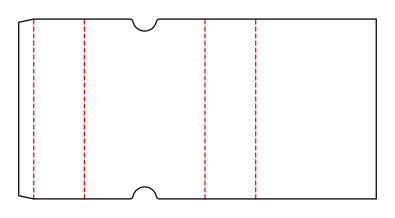 Folding cartonsSleevecarton.sleeve
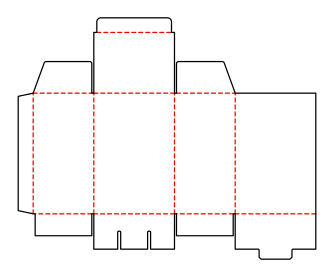 Folding cartonsCarton with snap-lock bottomcarton.snaplock
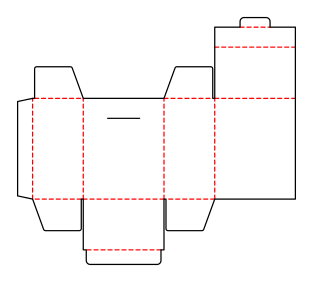 Folding cartonsHinged lid cartoncarton.hinged.lid
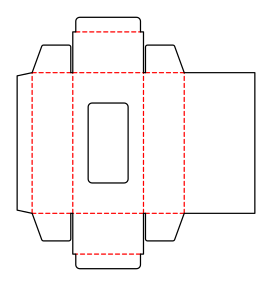 Folding cartonsTuck end carton with windowcarton.window
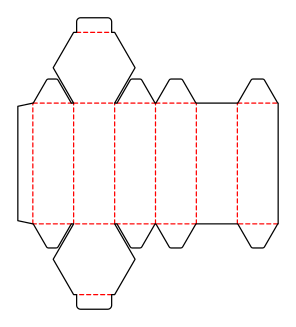 Folding cartonsHexagonal cartoncarton.hexagon
Customise the Pillow box in your browser
Set dimensions and material, review findings and export print-ready as PDF, SVG or DXF.