Folding cartons
Hexagonal carton
Folding carton with a hexagonal footprint formed by six walls and a glue flap, hexagonal lid and bottom with tuck flaps and mitered dust flaps. Dimensions: across corners × across flats × height.
Opens the online editor with this template. Try it without payment details; export with Pro.
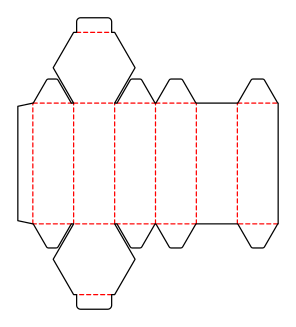
- Template
- Hexagonal carton
- Category
- Folding cartons
- Dimension reference
- Inside dimensions
- Default dimensions
- 81 × 70 × 120 mm
- Parameters
- 8
- Version
- v1
- Template ID
- carton.hexagon
Dimensions and limits
Default dimensions of the template and the permitted range in mm.
| Dimension | Default | Range |
|---|---|---|
| Length | 81 mm | 40–250 mm |
| Width | 70 mm | 30–200 mm |
| Height | 120 mm | 30–250 mm |
Parameters of this construction
8 parameters with default value and limits, adjustable in the editor.
| Parameter | Default | Range | Note |
|---|---|---|---|
Lid stylelidStyle | straight | straight · reverse | Position of the bottom: at the front like the lid (straight) or at the back (reverse). |
Glue flapglueFlap | 15 mm | 8–25 mm | Width of the glue flap used to glue the blank into a tube. The material requires a minimum width. |
Glue flap angleglueFlapAngle | 12° | 0–20° | Bevel at the ends of the glue flap; facilitates folding and erection. |
Tuck depthtuckDepth | 15 mm | 10–30 mm | How far the tuck flap reaches into the box; at most approximately half the width (the height for the mailer). |
Tuck flap radiustuckRadius | 4 mm | 0–10 mm | Corner radius of the tuck flap; limited by half the flap width or tuck depth. |
Tuck flap shouldertuckShoulder | 3 mm | 2–6 mm | Side inset of the tuck flap relative to the lid, allowing easy insertion. |
Dust flap length (ratio)dustFlapRatio | 70 % | 50–90 % | Dust flap length as a ratio of the available length. |
Dust flap reliefdustFlapReliefExpert | 2 mm | 1–5 mm | Distance between dust flap and lid along the crease; at least the material thickness. The machine requires a minimum slot width. |
Assembly
Pre-break the blank along all creases, glue the glue flap to the inside of the free edge of the last angled wall, and flatten the carton. Erect for filling, fold in the lower dust flaps, and close the bottom with the tuck flap. Close the top the same way after filling.
Grain direction
Grain direction parallel to the height: the six wall creases run lengthwise and fold cleanly through 60°, while lid and flap creases run crosswise (check with the test print shop).
Reference note
ECMA family, unconfirmed
Labels such as “similar to FEFCO” or “ECMA family, unconfirmed” are for orientation only. The templates are our own constructions; an assignment to a standard code is unconfirmed and not a trademark claim.
Frequently asked questions about this template
How do across corners and across flats differ?
Across corners measures over opposing corners; across flats measures between opposing parallel sides. These dimensions jointly describe the hexagonal cross section. Technical length corresponds to across corners, width to across flats. Do not use rectangular product dimensions without checking the hexagonal space and the required clearance.
Does the footprint have to be a regular hexagon?
The model accepts across corners and across flats separately and derives the angled walls from them. The wall creases have 60°; the front length must remain at least 20 mm. Not every combination within the table ranges is valid. Check the generated footprint against the product rather than assuming equal side lengths from the name.
What does the reverse lid style do?
lidStyle=reverse places the bottom at the back while the lid remains at the front. With straight, the bottom is also at the front. The six wall panels remain. The change affects the closure sequence and reading orientation of the bottom; check both on the fully erected sample with the intended artwork.
Why are the dust flaps mitered?
The flaps sit on the four angled walls. Their miters match the hexagonal end surface and are intended to leave room for the lid and tuck flap when folded in. Dust flap ratio and relief cut remain adjustable. Check folding them in together on the target board; the flat outline alone does not fully show possible stresses during closing.
Related templates
Customise the Hexagonal carton in your browser
Set dimensions and material, review findings and export print-ready as PDF, SVG or DXF.