Folding cartons
Carton tray with glued corners
Open tray made from folding carton board: base with four single walls; four corner glue flaps on the front and back walls are glued to the inside of the end walls.
Opens the online editor with this template. Try it without payment details; export with Pro.
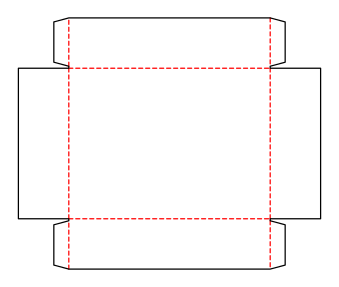
- Template
- Carton tray with glued corners
- Category
- Folding cartons
- Dimension reference
- Inside dimensions
- Default dimensions
- 200 × 150 × 50 mm
- Parameters
- 11
- Version
- v2
- Template ID
- carton.tray.glued
Dimensions and limits
Default dimensions of the template and the permitted range in mm.
| Dimension | Default | Range |
|---|---|---|
| Length | 200 mm | 40–350 mm |
| Width | 150 mm | 40–350 mm |
| Height | 50 mm | 15–120 mm |
Parameters of this construction
11 parameters with default value and limits, adjustable in the editor.
| Parameter | Default | Range | Note |
|---|---|---|---|
Corner glue flapcornerFlapWidth | 15 mm | 8–40 mm | Width of the glue flaps at the ends of the front and back walls, glued to the inside of the end walls. The material requires a minimum width; the flaps from both sides must not meet on the end wall. |
Corner glue flap tapercornerFlapAngle | 15° | 0–30° | Bevel at both ends of the corner glue flaps; the flap does not catch on the base or upper edge during erection. |
Flap gapflapGap | 2 mm | 0.2–5 mm | Gap between neighboring flaps or walls; at least approximately the material thickness. |
Windowwindow | off | on / off | Enable a viewing window with film margin (initially: disabled). It sits in the lid (mailer, hinged lid), in the front wall (trays), or in the front panel (gable, pillow); window, film margin, and 3 mm web must fit within the panel. |
Window shapewindowShape | rectangle | rectangle · oval | Shape of the window opening in the front panel. |
Window widthwindowWidth | 100 mm | 10–400 mm | Width of the window opening; window, film margin, and minimum web must fit between the front panel's creases. |
Window heightwindowHeight | 20 mm | 10–400 mm | Height of the window opening; window, film margin, and minimum web must fit between the lid and bottom creases. |
Window corner radiuswindowCornerRadius | 4 mm | 1–20 mm | Corner radius of the rectangular window; at most half the shorter window side and no smaller than the machine's blade minimum. |
Window position horizontalwindowPositionX | 50 % | 20–80 % | Window center as a ratio of the front panel width, measured from the left crease. |
Window position verticalwindowPositionY | 50 % | 20–80 % | Window center as a ratio of the front panel height, measured from the bottom crease. |
Film marginfilmMargin | 6 mm | 3–12 mm | Overlap of the window film around the opening, where it is glued on the inside; typically 5 to 8 mm. |
Assembly
Erect the front and back walls, fold the corner glue flaps inward, and apply adhesive to their outside. Erect the end walls and press firmly against the flaps (by hand or in a tray erector).
Grain direction
Grain direction horizontal on the blank (check)
Reference note
ECMA family, unconfirmed
Labels such as “similar to FEFCO” or “ECMA family, unconfirmed” are for orientation only. The templates are our own constructions; an assignment to a standard code is unconfirmed and not a trademark claim.
Frequently asked questions about this template
What holds the corners together?
Four corner glue flaps on the front and back walls fold inward and receive adhesive on the outside. The end walls are then erected and pressed against the flaps. The parametric construction describes this structure. Adhesive selection, pressing time, and actual strength depend on material and processing and must be checked on the sample.
Can the folding tray be assembled without gluing?
This ID describes glued corners. A separate catalog type is available for assembly with locking corners. Its foldovers, tabs, and slots change the blank. You therefore cannot simply omit gluing. Choose the appropriate construction and check its assembly using the actual material.
Which version does the page show?
The page shows V2 of the glued carton tray. This version adds an optional window in the front wall. The starting example uses the construction without a window. Template ID, version, and selected parameters remain visible in the data. This allows the preview to be associated with the correct construction state.
Can I use the tray for food?
Geometry alone does not confirm suitability for food contact. Material, coating, adhesive, and actual use must be checked separately. This page contains no such approval. Agree on the use case with the production partner; load capacity and protection of the contents also require a physical sample.
Why is the grain direction still unconfirmed?
The catalog recommends grain direction parallel to the length so the long creases process well and the walls bend less. The recommendation explicitly needs checking. With the actual board, inspect pre-breaking, erection, and stability; only the documented result confirms the direction for your use.
Related templates
 Folding cartonsCarton tray with lock cornerscarton.tray.locked
 Folding cartonsCounter displaycarton.display.counter
 Folding cartonsDispenser carton with tear-out windowcarton.dispenser
 Folding cartonsSleevecarton.sleeve
 CorrugatedFolding tray with lock cornerscorrugated.tray
 Folding cartonsStraight tuck end cartoncarton.tuckend.straight
Customise the Carton tray with glued corners in your browser
Set dimensions and material, review findings and export print-ready as PDF, SVG or DXF.