Corrugated
Mailer box
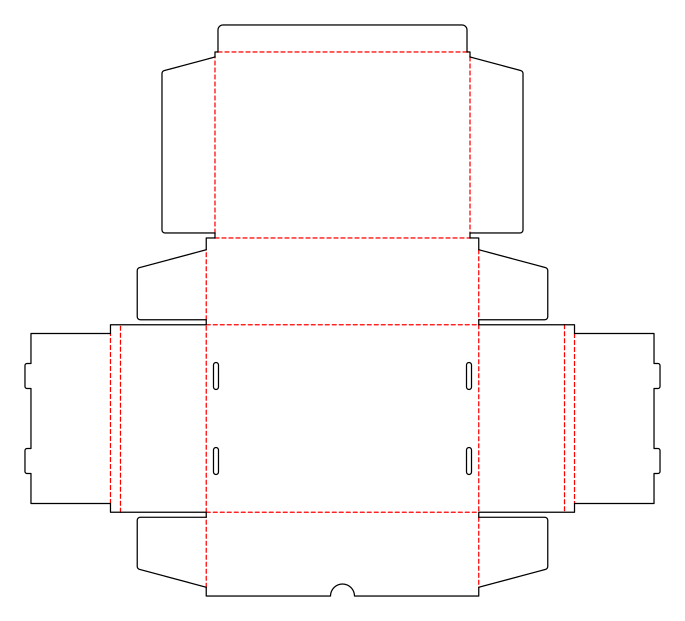
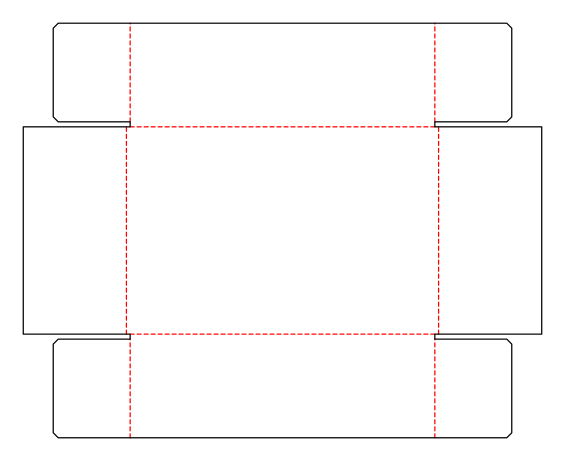
Corrugated shipping box with tuck lid: base in the middle, double side walls with locking tabs, ears on front and back walls, lid with dust flaps and tuck flap; without gluing.
Opens the online editor with this template. Try it without payment details; export with Pro.
- Template
- Mailer box
- Category
- Corrugated
- Dimension reference
- Inside dimensions
- Default dimensions
- 250 × 180 × 80 mm
- Parameters
- 23
- Version
- v3
- Template ID
- corrugated.mailer
Dimensions and limits
Default dimensions of the template and the permitted range in mm.
| Dimension | Default | Range |
|---|---|---|
| Length | 250 mm | 60–600 mm |
| Width | 180 mm | 60–600 mm |
| Height | 80 mm | 20–300 mm |
Parameters of this construction
23 parameters with default value and limits, adjustable in the editor.
| Parameter | Default | Range | Note |
|---|---|---|---|
Rim widthrimWidth | 10 mm | 3–20 mm | Width of the double wall's foldover (crease to crease); accommodates the flaps in the pocket. |
Flap gapflapGap | 5 mm | 1–10 mm | Gap between neighboring flaps or walls; at least approximately the material thickness. |
Ear length (ratio)earRatio | 80 % | 50–95 % | Length of the ears or corner flaps as a ratio of half the inside width. |
Lid dust flaps (ratio)lidFlapRatio | 70 % | 30–95 % | Length of the lid's dust flaps as a ratio of the inside height. |
Dust flap angledustFlapAngle | 15° | 0–30° | Bevel of the dust flaps (also the ears on the mailer); larger angles prevent collisions during folding. |
Tuck depthtuckDepth | 30 mm | 10–80 mm | How far the tuck flap reaches into the box; at most approximately half the width (the height for the mailer). |
Tuck flap radiustuckRadius | 5 mm | 0–20 mm | Corner radius of the tuck flap; limited by half the flap width or tuck depth. |
Tuck flap shouldertuckShoulder | 3 mm | 1–15 mm | Side inset of the tuck flap relative to the lid, allowing easy insertion. |
Lock tabslockTabs | on | on / off | Locks the inner walls with tabs in slots in the base. |
Number of lock tabslockTabCount | 2 | 1–4 | Number of locking tabs per wall. |
Lock tab widthlockTabWidth | 25 mm | 10–60 mm | Width of a locking tab. |
Lock tab depthlockTabDepth | 6 mm | 2–15 mm | How far a locking tab protrudes; at least material thickness plus clearance. |
Bottom slot widthslotWidth | 5 mm | 1–10 mm | Width of the slots in the base for the locking tabs; at least the material thickness, with clearance from the crease. |
Thumb notchthumbNotch | on | on / off | Semicircular opening at the front edge for easy opening. |
Thumb notch radiusthumbNotchRadius | 12 mm | 5–30 mm | Radius (= depth) of the thumb notch. |
Windowwindow | off | on / off | |
Window shapewindowShape | rectangle | rectangle · oval | |
Window widthwindowWidth | 120 mm | 10–400 mm | |
Window heightwindowHeight | 80 mm | 10–400 mm | |
Window corner radiuswindowCornerRadius | 4 mm | 1–20 mm | |
Window position horizontalwindowPositionX | 50 % | 20–80 % | |
Window position verticalwindowPositionY | 50 % | 20–80 % | |
Film marginfilmMargin | 6 mm | 3–12 mm |
Assembly
Erect the front and back walls and fold the ears inward. Erect the side walls over them, fold the foldover inward, and insert the tabs into the base slots. After filling, close the lid, fold in the dust flaps, and insert the tuck flap.
Grain direction
Grain direction vertical on the blank (check)
Reference note
similar to FEFCO 0427 · classification unconfirmed
Labels such as “similar to FEFCO” or “ECMA family, unconfirmed” are for orientation only. The templates are our own constructions; an assignment to a standard code is unconfirmed and not a trademark claim.
Frequently asked questions about this template
Which flute is suitable for the mailer?
The catalog example lists E flute or microflute. Starting profiles for B and C are also available. Selection depends on the product and production. The profile is not calibrated. Check fit, locking, and protection on the target material before approving the series.
Why does the mailer have double walls?
The side walls fold inward and are held by tabs in the base. The ears sit inside them. Multiple folds change the available space and accumulate crease allowance. The preview shows this construction but does not confirm load capacity; check that on the physical sample.
How much clearance does my product need?
There is no universal value for every product. Measure product, insert, and closure, and account for the filling workflow. The material profile changes the final fit. A mathematically valid inside dimension is therefore not enough. Determine clearance using a sample made from the actual corrugated board.
What does inside printing mean?
Inside printing places artwork on the inner print side. The artwork PDF is mirrored for this; the construction retains its dimension reference. Folded-over wall panels become visible differently after folding. Therefore check a sample marked on both sides and agree on print side and reading direction with the print shop.
Can I send the file to the print shop?
The production dieline, artwork PDF, and production sheet form the handoff. If machine profile, flute direction, and file conventions are not yet settled, the file initially serves as a basis for coordination. The reference classification is unconfirmed. Prototypes in three sizes and approval by the production partner are still pending.
Related templates
Customise the Mailer box in your browser
Set dimensions and material, review findings and export print-ready as PDF, SVG or DXF.