Folding cartons
Sandwich wedge
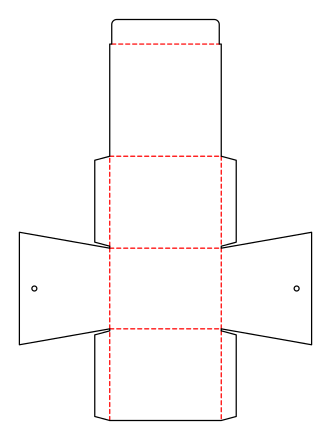
Triangular prism for a halved sandwich: body made from bottom and two sloping sides with a longitudinal seam, glued-in triangular back, and triangular hinged lid with tuck flaps. Dimensions: baseline × thickness × triangle height.
Opens the online editor with this template. Try it without payment details; export with Pro.
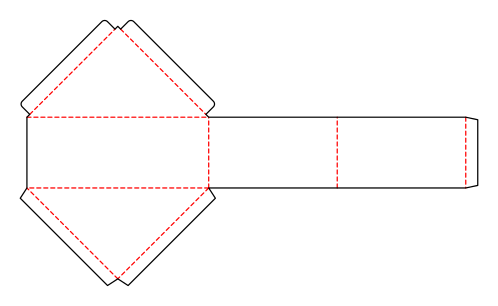
- Template
- Sandwich wedge
- Category
- Folding cartons
- Dimension reference
- Inside dimensions
- Default dimensions
- 180 × 70 × 90 mm
- Parameters
- 5
- Version
- v1
- Template ID
- carton.wedge
Dimensions and limits
Default dimensions of the template and the permitted range in mm.
| Dimension | Default | Range |
|---|---|---|
| Length | 180 mm | 80–300 mm |
| Width | 70 mm | 30–120 mm |
| Height | 90 mm | 30–200 mm |
Parameters of this construction
5 parameters with default value and limits, adjustable in the editor.
| Parameter | Default | Range | Note |
|---|---|---|---|
Glue flapglueFlap | 12 mm | 8–25 mm | Width of the glue flap used to glue the blank into a tube. The material requires a minimum width. For the wedge, no more than 40 % of prism thickness. |
Glue flap angleglueFlapAngle | 12° | 0–20° | Bevel at the ends of the glue flap; facilitates folding and erection. |
Tuck depthtuckDepth | 15 mm | 10–30 mm | How far the tuck flap reaches into the box; at most approximately half the width (the height for the mailer). For the wedge, no more than half the prism thickness. |
Tuck flap radiustuckRadius | 4 mm | 0–10 mm | Corner radius of the tuck flap; limited by half the flap width or tuck depth. |
Tuck flap shouldertuckShoulder | 4 mm | 2–6 mm | Side inset of the tuck flap relative to the lid, allowing easy insertion. |
Assembly
Pre-break all creases in the blank and glue the longitudinal seam to the inside of the bottom. Apply adhesive to the back's glue flaps, swing the back into place, and press the flaps against the inside of the sloping sides. After filling, close the hinged lid and insert the tuck flaps inside against the sloping sides.
Grain direction
Grain direction parallel to the body creases (vertical on the blank): Bottom and sloping sides fold neatly around the triangle corners (check with a test print shop).
Reference note
No external reference assigned; original construction type.
Labels such as “similar to FEFCO” or “ECMA family, unconfirmed” are for orientation only. The templates are our own constructions; an assignment to a standard code is unconfirmed and not a trademark claim.
Frequently asked questions about this template
How do I measure a halved sandwich?
Measure the baseline along the cut edge, thickness as the distance between the two triangular faces, and height perpendicular above the baseline. For an isosceles right triangle, height is half the baseline. Account for actual contents and required clearance.
Can I enter outside dimensions?
This version offers inside dimensions only. The model offsets the inner triangle outward by the crease offset and calculates the body from it. No outside dimension parameter is offered for this wedge. Use measured product dimensions with appropriate clearance and check the resulting outer shape on a material sample; the simplified compensation still needs practical confirmation.
Why are base angles limited?
The template allows base angles from 25 to 70°. The ratio of baseline to height determines this angle. Very flat or very tall triangles may therefore be rejected despite valid individual dimensions. Change the proportions together. The limit protects the intended dimension model and does not replace checking whether the specific sandwich with filling fits inside.
Which side is glued and which opens?
The body's longitudinal seam is glued to the inside of the bottom. The triangular back is attached to the inside of the sloping sides through its glue flaps. The opposite triangular face is a hinged lid with two tuck flaps. Keep these roles separate in artwork and check the filling path before permanently gluing the back.
Why is a wide glue flap rejected?
The glue flap may occupy no more than 40 % of prism thickness while also meeting the material minimum. For thin packaging, these limits may be close together. A wider flap would take space the construction needs for other parts. Check material profile and thickness together; simply reducing the flap may violate the minimum width.
Related templates
Customise the Sandwich wedge in your browser
Set dimensions and material, review findings and export print-ready as PDF, SVG or DXF.